
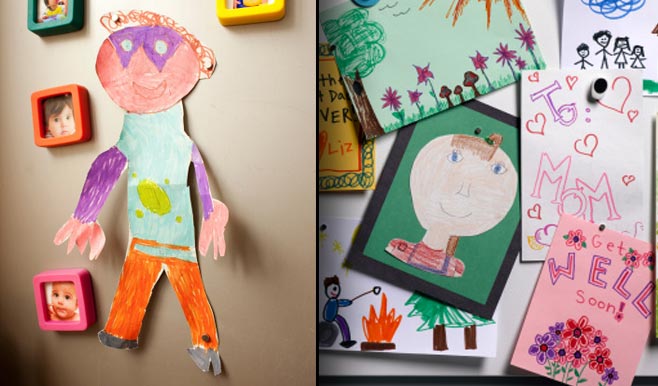
Children’s drawings have certain universal qualities which fit into particular stages. Every child's development is unique and complex. Although children develop through a generally predictable sequence of steps and milestones, they may not proceed through these steps in the same way or at the same time. A child's development is also greatly influenced by factors in his or her environment and the experiences he or she has.
Below is information which shows the development of a child’s body image drawing from a baby up to 6 years old. Please consider what you read in the context of your child's unique development.
6 months to 2 years
.jpg "childrens body image")
The child begins to draw with uncontrolled scribbles. He then starts to control his scribbles and elongates them into long lines. Then he begins to draw in different directions and gradually closed forms are created and shapes emerge from the longitudinal and circle lines. The child may give names to, or remark about his drawings.
.jpg "childrens body image")
Once the child has control over his crayon it is important to show him the correct grip to hold his crayon
3 - 4 years old
.jpg "childrens body image")
The circular scribbles become ‘heads’ while the longitudinal scribbles become ‘bodies’ - a ‘Head-man” drawing is created.
4 -5 years old
.jpg "childrens body image")
The child adds more body parts to his picture. He draws a head, (eyes, nose, mouth, ears) neck, body, arms and legs attached to each other.
5 – 6 years old
.jpg "childrens body image")
The child develops his body image drawing even further. He begins to add eyebrows and eyelashes to the face. The neck, arms and legs are no longer sticks but rectangles creating a 3-Dimensional affect. The hands are drawn with five fingers and the feet are drawn with five toes. The children begin to start drawing clothes and shoes.
6 – 7 years old
.jpg "childrens body image")
The child uses a wider variety of materials to create visual images that combine colours, forms and lines. He is more aware of spatial relationships. ‘A base-line’ now appears as the child draws the ground.
Once your child has begun to purposefully draw images, she has mastered symbolic thinking. This important milestone in thinking skills means that your child understands that lines on paper can be a symbol of something else, like a house, a cat or a person. At this stage, your child also begins to understand the difference between pictures and writing. So you may see him draw a picture and then scribble some "words" underneath to describe what he has drawn or to tell a story. When your child is able to share his story with you, he will be motivated to "author" more and more work as he grows.
